
Artifacts of the Future
by Rutuja Jog
Water conservation system design

Governance of Water Conservation in India: A Systemic Approach to Addressing Water Shortage
October 2025
Timeline
July 2017 - April 2018 (9 months)
Topic of Focus
Water shortage on the farms of Western Maharashtra in India
Why this topic?
I chose this topic from my personal experience and observations as an Indian citizen.
Current Situation
About 330 million people in India are affected by drought
Vision
To optimize water usage to increase the availability of water for 1 million rural households
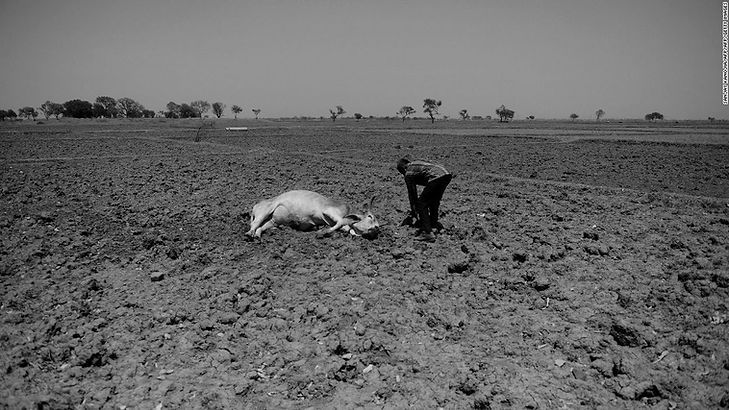
The Problem
17% of the world’s population resides in India and it has to rely on 0.04% of the total rainfall in the world

Diagnosis of the Problem
1

Reliance on groundwater for 70% of irrigation needs.
This is a problem because using groundwater for irrigation pulls from the most accessible source of drinking water.
2

Irrigation techniques have only 35% of precision
This means that 65% of water goes to waste.
Area of Opportunity
Optimization of water consumption in surface irrigation
Functioning of Surface Irrigation
In the method of surface irrigation, water is released in the field from the high point of gravity to the low point of gravity through furrows. The water is allowed to flow freely in the field for several hours.
While that is the method in use, many farmers are not aware of the fact that the plants only require the amount of water that reaches the root zone. Any water that percolates beneath the root zone goes to waste.

Root Zone
Furrows
Potential Impact
If 50% of farmers optimize water consumption in surface irrigation, that would lead to at least 5% increase in water conservation in agriculture. If that 5% is diverted for domestic usage, it could double the amount of currently available drinking water.
Possible challenges
Lack of motivation to optimize water usage.
Proposed intervention 1
Technological solution
Smart Sinachan: translated as smart irrigation
First-order cybernetic system
System Goal: Maintaining an adequate amount of water in the soil for a crop’s healthy growth

Smart
1.
The moisture sensors are programmed with the amount of water content required in the soil for the growth of a particular crop
2.
As the amount of water in the soil drops below the threshold, the system switches the water pump on
3.
The system switches the pump off when the required amount of water in the soil is obtained
To achieve a greater efficiency...
..the system would be linked to a third-party weather app so that it would operate based upon the weather forecast and hold off irrigation on a day where heavy rainfall is predicted.
Machine learning for increased efficiency
.png)
Simulation of the system functionality
*The animation will auto-play
Click here to enlarge the animation
Click here to play from the start
Key Stakeholders
.png)
Farmers (end-user)
Baby boomer and gen X men, since they are mostly the landowners and responsible for decision making related to farming tasks.

Village committee
The elected officials in the village communities have an influence over the behaviour of individuals, making their buy-in critical.

Central government
Agriculture plays an important role in the Indian economy. Therefore, the government is supportive of the systems leading to the farmers’ wellbeing.

Volunteers
The volunteers act as an immediate support system, providing the farmers with hands-on assistance with installation and troubleshooting.

State government
State governments are responsible for statewide budgeting and policies related to water conservation, making their involvement vital.

Manufacturing companies
Indian manufacturing giants will contribute in funding and collaborate on R&D as a part of their Corporate Social Responsibility requirements.
Other stakeholders
-
Buyers
As an incentive for using the system for water conservation, the farmers would get access to wholesale grocery vendors, retailers and grocery chains who can buy their yield in bulk.
-
Smart Sinchan team
The group of people responsible for ideation, mediation and execution of the proposed system for water conservation.
-
Regional non-profit organizations
The regional non-profits, having the shared goal of water conservation, can collaborate with the Smart Sinchan team for greater impact and outreach.
-
International non profit organizations*
*If this system of water conservation is successful, then the international non-profits can help scale it to other countries with water scarcity.
Farmer needs, behaviours and challenges
User Interviews
Research sample:
Five Indian and Five American farmers who use surface irrigation
1.
Irregular availability of electricity affects the use of water pump
If there is no electricity during the day, the farmers switch the pump on at night and let the water run throughout the night which causes a great amount of water waste.
2.
Indian farmers use 8 times more water than American farmers
An average Indian farmer waters a 10 acre farm for 8 hours and an American farmer waters a 10 acre farm for 1 hour or less.
3.
High cost of good quality seeds and fertilizers is one of the big pain points of the Indian farmers
4.
A number of farmers end up in debt due to low profit
Due to the high cost of good quality seeds and fertilizers, the farmers end up harvesting poor quality yield, which leads to low profit and lands them in debt
.png)
Farmer's journey
+ stakeholder engagement touch-points
Prototype
Android mobile app
Why a mobile app?
According to the May 2025 Press Release by the Ministry of Statistics & Programme Implementation, In India, approximately 85.5 percent of households possessed at least one smartphone. Around 86.3 percent households in India have access to internet within the household premises.
App user flow

Onboarding information related to farm size, soil type, corps cultivated etc. these factors would guide the starting point of the system's learning.
Entry point to the buyer's portal, where, interested buyers and farmers can connect.
Prototype
Click here to reset
Click here to interact with the prototype
Cultural Context
Secondary research

Role of agriculture
As of 2023, agriculture made up 16% of India's GDP. Most of the crops that India produces in large amounts are water intensive.

The caste system
Indian constitution rejects the traditional caste system that divides the society into hierarchies of importance and has designed a reservation system to uplift the socially backward classes.

Government dynamics
The central and state governments in India have recently been characterized by high tensions due to the competition for investment opportunities and job creation.

The village community
The Indian village communities are characterized by a traditional and close-knit social fabric, where, the community members rely on each other's assistance.

Culture of honour
Honor plays an important role in Indian communities, leading individuals to seek activities and relationships that are known to be a "social currency", resulting in high honor.

Water conservation policies
Indian government has had several policies for water conservation that include groundwater management, flood management and improved irrigation.
Proposed intervention 2
Social system
Stakeholder goals and incentives mapping
With an exception of the non-profits, water conservation is not a prime goal of any of the other identified stakeholders. Hence, to motivate each one to contribute to water conservation, the social system will provide incentives to each stakeholder based on gains based in money or honour.
.png)
Conversations for conservation

Based on their role and goals, various stakeholders will have conversations with each other to form an ecosystem of conversations aimed at water conservation.
Self-observation, learning and evolution
An intelligent self-correcting cybernetic system is rooted in self-observation. In this scenario, the self-observation will be achieved through an ability of each stakeholder and non-stakeholder to observe the functioning of the system through transparency and suggest interventions for innovations or raise enquiries for accountability, leading to learning and evolution.
A few ways that could be achieved:
-
Educational advertising campaigns informing the citizens on ways that they can observe and hold the stakeholders accountable.
-
Open sharing of information with a digital footprint of various forms of documentation that anyone can follow.
-
Inquiry requests that allow any citizen to investigate into possible malpractices.
.png)
Meta-system of water conservation
If the proposed system is able to conserve at least 2% more water in India within 5 years, then this system can be scaled at a global level for a possible adaptation by other water-stressed and water-scarce countries. This could be achieved with the help of global organizations working on water conservation.
