
Artifacts of the Future
by Rutuja Jog
Universal transaction system design


Patent nominated
Goal
To identify and design a speculative intervention in connected mobility for Panasonic Automotive, one that reimagines the relationship between personal identity, autonomous vehicles, and public infrastructure through the lens of Google's Fuchsia OS.
Timeline
January 2018 - April 2018

What is Fuchsia OS?
*All the research was conducted in 2018
-
Fuchsia is a secure computing-based OS currently being developed by Google. It is an early-stage experimental project at the moment (2018).
-
It is estimated that Fuchsia will have an ability to run on universal devices, from dash infotainment systems for cars, to embedded devices like traffic lights and digital watches, all the way up to smartphones, tablets and PCs.
-
It operates on the Zircon micro-kernel system intended for embedded systems.
-
It could potentially unify Chrome OS and Android into a single operating system or even replace Android altogether.
Functioning of Fuchsia

Integration of public and private devices
Advantages
-
Secure computing-based OS
Unlike Linux, Fuchsia is not an open-source OS. Hence, it is more adaptable as well as secure.
-
Connecting Universal Devices
It is estimated that Fuchsia will have the ability to run on universal devices through a single login, which would take the Internet of Things to the next level.
-
Inclusion of Embedded Systems
Fuchsia can run on embedded systems from dash infotainment systems for cars to traffic lights.
Disadvantages
-
Security concerns on public devices
Since the OS can run on universal public or private devices, that means if there is a security breach, it can affect the entire connected device ecosystem.
-
Data privacy issues
Through Fuchsia, a user’s data can be shared across personal as well as private devices. If that data leaves cookies behind, then it can be retrieved and misused.
-
Challenges in switching to Fuchsia and the learning curve
Users who have been using platforms such as Windows or Apple devices may be reluctant to switch over to Fuchsia. Most users would go through a learning curve to adapt to fuchsia.
Research
Research Questions
-
How do people establish trust with new technology?
-
How would they feel about connecting a public device to their private profile?
-
How can such a system ensure data security for them?
-
What would discourage them from using such a system?
-
What do people think is the future of mobility, and how would they feel should it become a reality?
Assumptions
-
Users who are comfortable using an autonomous vehicle will be more likely to trust and see the value of a universally connected device ecosystem.
-
The younger population with busy lives will be more inclined to use such a system for higher task efficiency.
-
This effort would require a significant buy-in from the stakeholders of various ecosystems, such as the government, since it allows an integration of public systems in the connected device ecosystem.
Research methodologies
-
Industry trends insights (2017)
-
User interviews
Industry trends insights
-
Generations Y and Z demonstrate a high degree of confidence and investment interest in emerging technologies.
-
Strategically targeting these cohorts for systems powered by Fuchsia OS is likely to accelerate adoption and drive widespread market penetration.
User interviews
Sample size
3 individuals who belonged to Gen Y or Gen Z, and either owned or rented a vehicle
Findings
User stressors
-
Being able to trust public devices with sensitive information, such as a credit card.
-
Fear of getting scammed.
-
Data security and privacy, and a fear of possible identity theft - what if your personal information gets leaked?
Establishing trust with public devices
-
If the brand is trusted, then it's easier to trust the products and services associated with it.
-
Proven capability of the brand to secure the data is key.
-
Safety protocols such as a two-step authentication.
-
Getting prompts about all of my activity, or a place where I can check all activities linked to my personal data and account.
-
Having control over your own data, such as removing devices or reporting suspicious activity.
Areas of opportunity
-
HMW utilize the brand images of Panasonic Automotive and Google to communicate with users on ensuring their data privacy and security?
-
HMW provide users with an authentication process that guarantees higher security?
-
HMW give users greater control and transparency over their data usage?

The idea
A speculative system design for a near-future where personal and public devices share a single OS layer, exploring what new interaction paradigms become possible when the boundary between your devices and the world's infrastructure disappears.
What makes this concept novel
-
A single OS-agnostic interface surfaces all compatible public devices as Points of Interest, eliminating the need for multiple apps across different vendors, locations, or transaction types.
-
One unified interface handles multiple transaction types with a single default payment method, reducing the steps between intent and completion to a minimum.
-
For the first time, an autonomous vehicle can be dispatched to complete physical-world transactions independently, getting fuel, picking up food, and collecting medicines, without a human present at any point in the process.

Use cases storyboard
Created using https://app.boords.com/
Use case 1
Using the Panasonic Automotive-operated device-agnostic interface powered by Fuchsia OS to allow an autonomous vehicle to perform tasks without a human present.

She opens her ‘Universal Transaction Device Map’ and selects a Starbucks drive-through location nearby.

She sets the autonomous vehicle destination to the Starbucks location and back. She then uses her Fuchsia interface to place an order at that Starbucks, pays for it and provides them the vehicle plate.

The drive-through machine’s interface, which also runs on Fuchsia OS, detects the vehicle and sends an authentication code to Nina’s phone.

After authenticated, the barista hands Nina’s order off to the vehicle.

The vehicle drives back with Nina’s breakfast.
.png)
Nina works from home as a developer. One day, she wakes up late and has to start working right away.

She wants to have her morning coffee and breakfast, but doesn’t want to use takeout apps, since they tend to overcharge.

Nina owns an autonomous vehicle and has connected all her personal devices to Fuchsia OS.
Use case 2
Using the Panasonic Automotive-operated device-agnostic interface powered by Fuchsia OS to complete multiple transactions remotely through a single interface.


After that, his payment for the fuel purchase gets deducted from his credit card, already linked with his Fuchsia profile.

Then, after he goes to the drive-through, his coffee is ready.

He again confirms his identity by a thumbprint, takes the coffee, and then the payment for the coffee gets deducted from his card on his profile.

Joe downloads Fuchsia OS on his laptop and connects all his personal devices to his Fuchsia account in the cloud.

Joe wants to travel from Farmington Hills to Detroit.

He gets into his car, where the IVI of his car, being one of his personal devices, is powered by Fuchsia OS.

As he starts to drive, his car indicates that it is running short on fuel.

On the IVI interface of the car, he selects the ‘Universal Transaction Device Map’ to search for gas stations around his current location.

The device map feature displays all the point of sales devices in the area that run on Fuchsia OS. He finds a Marathon station located at the next exit.

He clicks on the icon of that station, which opens a page for him to 'book a spot' and process a purchase at that particular gas station remotely using a credit card associated with his account.

He also feels like buying a coffee from a Starbucks that is close to the gas station.
He clicks on the Starbucks drive-through icon and purchases the coffee remotely.
While the order of his coffee is being processed, he reaches the location of the gas station, confirms his identity by his thumb print on the gas station and fills the fuel in his car.
User flow
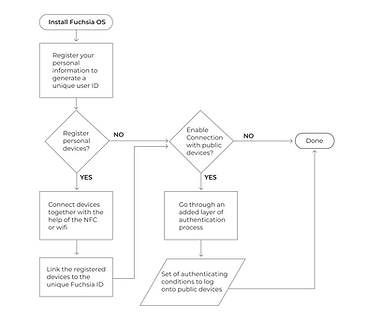
Registration with Fuchsia
.png)
Universal transaction device map
.png)
Flow summary
The user flow operates on two levels - registration, which establishes a unified identity across personal devices, and transaction, which allows that identity to authenticate and complete purchases across any compatible public infrastructure, with or without the user physically present.
Infotainment System Interface Concept

The device map landing page on the infotainment system

The user can select a gas station, input the estimated amount of gas and reserve a spot in the gas station's Fuchsia-operated system.

"Gas station" as a search query gives options for gas stations in the area.

The user can then select a payment method to pre-pay the amount which will be deducted when the payment is complete.

The user can immediately go on to process a completely different transaction and sync with different public devices through the same interface at any point in time.
Patent nomination
This interface concept was nominated for a patent by Panasonic Automotive, recognizing it as a novel invention - an early conceptualization of an OS-agnostic universal transaction interface for connected and autonomous vehicles.
Open questions for future inquiry
-
Under what circumstances are humans willing to delegate physical-world tasks to an autonomous personal system, and where do they draw the line?
-
How do existing mental models of ownership and presence need to evolve when a vehicle can act as a proxy in the physical world?
-
What new accountability structures are needed when a machine completes a transaction without a human present?
-
How might a universal OS layer reshape the relationship between private identity and public infrastructure at scale?
-
As artificial general intelligence matures, how might it reshape the trust and accountability dynamics of delegated machine agency in public infrastructure?