
Artifacts of the Future
by Rutuja Jog
Pollution monitoring system design
Goal
To design an intervention to a problem that is affecting the local communities in the city of Detroit.
Timeline
January 2017 - April 2017
Problem area
Air pollution in Detroit
Research Foundations
Investigation methods
Cybernetic modeling
Systems thinking
Civic Technology
Systems papping
Concept mapping
Iterative prototyping
Literature Review
Outdoor air pollution
-
Ground-level Ozone Pollution in the Detroit metro area:
-
Number of Unhealthy Days per Year: 6.2 days (5.7 days in 2024 report)
-
Grade: F (F in 2024 report)
-
National Ranking: 45th worst (33rd worst in 2024 report)
-
-
Particle Pollution in the Detroit metro area:
-
Number of Unhealthy Days Per Year: 8.5 days (4.8 days in 2024 report)
-
Grade: D (F in 2024 report)
-
National Ranking: 22nd (35th worst in 2024 report)
-
-
Year-Round Average Level of Particle Pollution in Detroit metro area:
-
Grade: Failing grade, pollution levels above the federal standard (failing grade in 2024 report)
-
National Ranking: 6th worst (13th worst in 2024 report)
-
Source: American Lung Association
All the research was updated in 2025 for statistics accuracy
Indoor air pollution
-
According to the U.S. Environmental Protection Agency (EPA), indoor air can be more polluted than the outdoor air in the biggest, most industrial cities. With Americans spending 90% of their time inside where air pollutant concentrations can be 2 to 5 times higher, seeking refuge indoors may actually be posing greater health risks.
-
A study for the National Institute of Health (NIH) revealed that 59% of indoor particulate matter during the winter and 84% of indoor particulate matter during the summer originated outdoors.
Air pollution concept map

OUTDOOR POLLUTION
DETROIT
Target area
-
According to an article published in 2010, "sandwiched between I-75 and some of Michigan's largest industrial plants, Detroit's 48217 ZIP code is the state's most polluted, according to an analysis by University of Michigan environmental scientists".
-
Jeff Korniski with EGLE’s Air Quality Division told Planet Detroit “I think it’s fair to say that under almost any measure, the 48217 zip code and the surrounding zip codes bear a heavy burden of pollution.”
Source: Planet Detroit
Target audience
Citizens of Detroit with asthma
Why?
-
The Asthma and Allergy Foundation of America listed Detroit as the most challenging city in the nation to live with asthma in 2025, while the American Lung Association gave the region an “F” rating for air quality in its annual State of the Air Report.
Source: PRISM -
Based on an article "How air pollution and asthma affect kids in Detroit" Children with Asthma in some areas of Detroit are unable to go outside and play freely because of the high level of air pollution. Not only that but claims suggest that the air pollution exposure in their neighbourhoods that can make children susceptible to Asthma, since Detroit is the city that has the highest childhood asthma rate.
Source: Planet Detroit
Research question
How might we design a system that gives citizens of Detroit the agency to act on air pollution in real time, while building trust in the civic systems responsible for their safety?
Theoretical Precedent
Project Cybersyn
- Project Cybersyn was a distributed decision support system to aid in the management of the national economy in Chile.
- Cybersyn was designed for effective communication and collaboration, intended to drive efficient decision-making.
- It conceptualized the use of machine learning, where the system would analyze the patterns of production data and predict the future behaviours of the economy - a concept similar to the modern-day Internet of Things.
- Cybersyn wasn't just an IoT system - it was a real-time nervous system for a whole society, designed to sense distress and respond before it became a crisis.

The idea
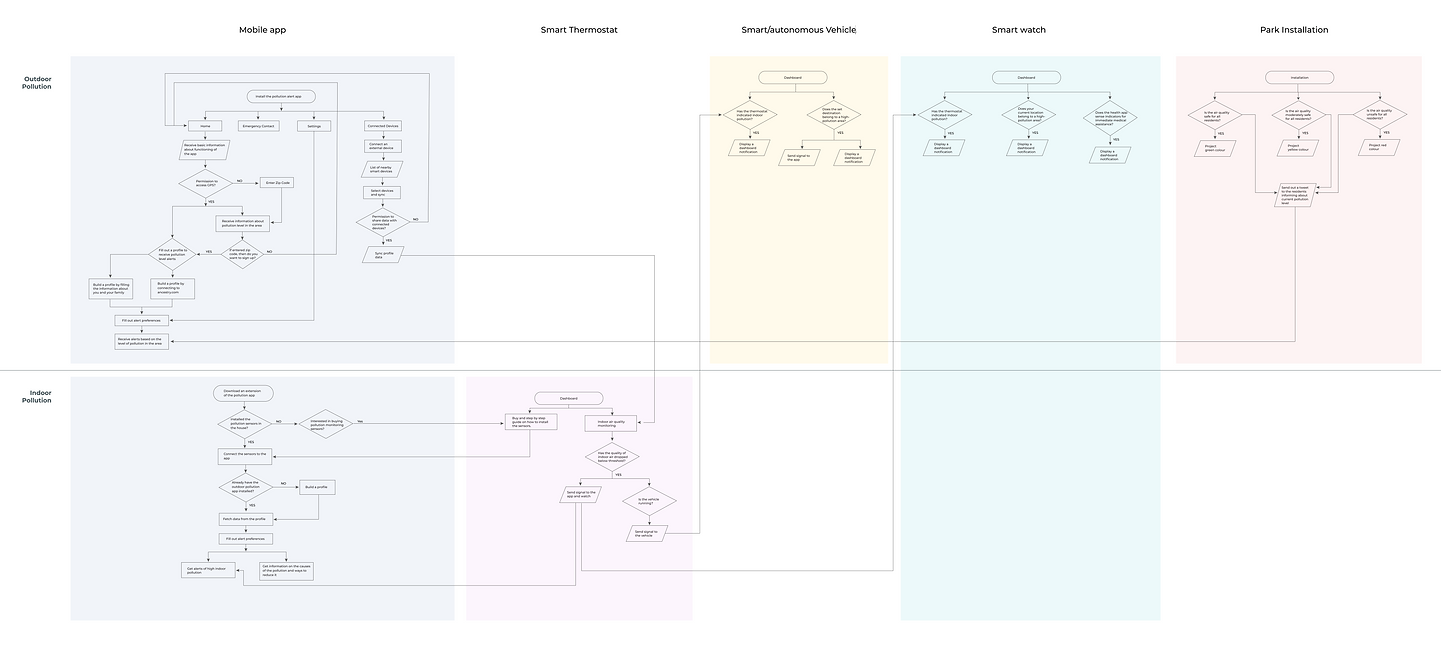
The ubiquitous system of air pollution monitoring

-
The park installation will send out real-time alerts on the quality of air to those who visit the park by blinking red, orange or green light, indicating polluted, moderate, or fresh air, respectively.
-
The mobile app will collect each person's health data per household and will send personalized alerts on pollution levels, along with getting quick help in case of a medical emergency.
-
The smart thermostat will feed the data into the mobile app on indoor pollution.
-
The smart watch will be particularly helpful in alerts that require prompt action.
-
The vehicle infotainment system will be synced with the app and the smart watch, customizing the alerts based on location.
-
Various social media platforms will be linked to the mobile app and the installation, sending real-time updates on pollution levels for public safety, and feed information to the app to help refine the alert system of the connected devices by collecting data through crowdsourcing.
Collectively, this data will be monitored by the City of Detroit to take measures to manage air pollution before it becomes a crisis. Similar to project Cybersyn, the connected device system here works as a community nervous system, alerting a social body to danger.
System diagram of connected devices
.png)
Subject of investigation
Piwok park
- Located in the highly polluted 48217 zip code of Detroit.
- Has a vicinity to the Marathon petroleum refinery.
- Went through a reconstruction and beautification effort in 2025.
Piwok park in pictures


PROTOTYPE
The Piwok Park installation
-
The installation will send out real-time alerts on the quality of air to those who visit the park by blinking red, orange or green light indicating polluted, moderate, or fresh air respectively.
-
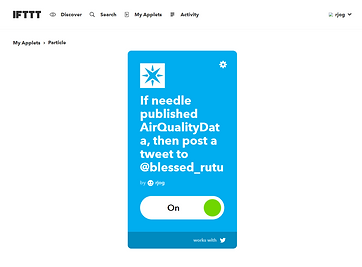
The system will also send out a tweet to communicate the status of air quality around the park

The physical prototype
Components

Process
1.
Test run each individual component for sanity check.

2.
Integrate Pollution Sensor, Particle Photon, Arduino and Neopixel with each other and run the code.

3.
Sync the code with the IFTTT applet
4.
Send out a tweet every time a change in the state of pollution level occurs

Code
.png)


Demo installation

Installation simulation at the park

Mobile app key wireframes


.png)


THE ALERT SYSTEM
The goal of the alert system is to notify citizens in zip code 48217 of air pollution levels so that children and people with health vulnerabilities can be taken care of accordingly.

.png)
Alert system for pollution levels
Measuring the success
In-app survey
-
Goal: measure the usefulness
-
Means: gather quantitative feedback from users on the usefulness of the system.
-
Success metrics: More than 95% users score 4/5 for overall usefulness.
Emergency calls tracking
-
Goal: measure the effectiveness
-
Means: Track the number of users who dialed emergency contacts or 911 either from the app or immediately after viewing the data from the app.
-
Success metrics: 100% of users got the medical care they needed.
Indoor pollution measurement
-
Goal: measure the efficiency and effectiveness
-
Means: Measure the number of times the smart thermostat indicated indoor pollution to the users.
-
Success metrics: Less than 2% of citizens who utilize the system have worse indoor pollution than before (indicative of users taking action to actively reduce indoor pollution).
What this experiment opens up
Questions to explore
-
How do communities respond differently to ambient public signals vs. private personal alerts?
-
Does public visibility of pollution data change behaviour or advocacy?
-
How might we adapt the solution to the needs of young children with Asthma?
-
How do we design data governance structures that keep marginalized communities in control of their own health data?
Next steps
-
Participatory co-designing with residents of 48217. This prototype was developed without direct community involvement, a significant limitation that the next phase would address through participatory co-design.
-
Conduct ethnographic research to understand the needs and pain points of patients with Asthma.
-
Conduct a contextual inquiry to learn about the role of the medical facilities.
-
Collaborate with subject-matter experts on designing a governance model for a connected pollution tracking system.